Blog

  • Outlook Error 0x800CCC0E – Unable to connect to the server

    Error 0x800CCC0E on clients connecting to a Plesk VPS manifests itself with several descriptions:

    Task ‘Checking for new mail in subscribed folders on your_account.com.’ reported error (0x800CCC0E)
    Outlook is unable to download folder (null) from IMAP e-mail server for account your_account.com.
    Error: Unable to connect to the server. If you continue to receive this message, contact your server administrator or Internet service provider (ISP).

    Assuming that there isn’t a problem connecting to the server (in my case mail was being sent and received, but IMAP folders would not synchronise) then the problem lies with Plesk limiting the number of mail client connections from a single IP address – four by default. To raise this limit:

    Login to Plesk
    Under Server Management, Click “Tools & Settings”
    Under Mail, Click “Mail Server Settings”
    Change the “Maximum number of connections per IP address” to a larger value, e.g. 40.
    Click “OK”
  • Plesk SMTP authentication error

    After several hours banging my head against the wall over an Outlook error “0x800CCC80; None of the authentication methods supported by this client are supported by your server” I finally found the cause of the problem; I had installed the postfix mail server on the new Plesk VPS host rather than qmail.
    Postfix requires TLS encryption on port 587, qmail does not – and the Outlook default is “None”. Changing the encryption required in Outlook is disruptive – lots of clients – and also gives rise to a certificate warning, so I decided to take the cowards way out and replace postfix with qmail.
    More here.

  • Programming The APC Smart UPS 700

    I have a Smart UPS 700 which after a battery change shows zero run time and a permanently lit “Trim” LED.

    The zero run time is because the battery constant held in EEPROM is wrong – I think that this is maintained by the Smart UPS as the battery capacity fades over time, but isn’t reset when a new battery pack is inserted.

    The Trim LED shows that the UPS thinks the supply voltage is too high. It isn’t, so in this case the firmware version in EEPROM is wrong, making the device think it is a US model and expecting a 120V supply.

    Both problems can be solved using the APC “black” serial cable P/No 940-0024 and a terminal emulator on the laptop.

    Lost the black cable, did you? Here is the wiring:

    UPS
    Signal Name
    DB-9 Male
    (UPS end)
    DB-9 Female
    (PC end)
    PC
    Signal Name
    TX / AC Fail 2 2 Rx, Received Data
    RX / Shutdown 1 3 Tx, Transmitted Data
    Common 9 5 GND
    Link 1 & 4 DCD,DTR
    Link 7 & 8 RTS,CTS


    Referring to the table below, the correct battery constant (register 0) is 96 (hex) and the firmware version is 52.11.I

    Connect the serial cable and using puTTY or similar issue the following commands:

    Press Y (Capital Y)
    UPS should respond SM
    Press 1, wait 2 seconds, press 1 again.
    You should see response PROG.
    Press 0  (zero).
    The UPS should respond with the current constant.
    Press + (plus) or - (minus) to increment/decrement the value
    Press R (capital R) to reprogram constant value
    The UPS should respond Bye
    Press Y
    The UPS should respond S
    Press 0 (zero)
    The UPS should respond with the new constant.
    Press b.
    You will see the current firmware code.
    Press either + or - followed by a 1 second pause followed by b to cycle through the firmware versions.
    Press R (capital R) to reprogram the firmware version.
    The UPS should respond BYE.
    Quit the console without resetting the serial port.

    That should be all that is required.

    Here is the table showing register 0 (battery constant) and Firmware for each UPS model:
    UPS Model 4 5 6 0 Hex Firmware
    SU250 EE F8 B1
    SU400 EE F8 9F E1
    SU600 EA F4 9F E5
    SU900 F3 FC 9F ED
    SU1250 EE FA 9F F5
    SU2000 F1 F9 9F FD
    SU450,700 28 F2 FA 96 07,RM=47 52.11.I
    SU450XL,700XL 28 EE F8 9F 700XL=27 51.9.I
    SU1000,INET 35 EF F9 A0 0B 60.11.I
    SU1000XL 34 EE FC 9A 2B 61.9.I
    SU1400 35 EE FC 9A 70.11.I
    SU1400RM 28 ED FA 89
    SU1400R2IBX135 08 B4 10 A3
    SU1400RMXLI3U 45 F6 F4 80 73.x.I
    SU1400RMXLI3U 20 F3 FD 81 73.x.I
    SU2200I 35 EE FB AF 90.14.I
    SU2200XL,3000 35 EE FB AF 3000=17 90.14.I
    SU3000RMXLI3Ublk 35 F3 F4 AF 77 93.14.I
    SU5000I white 20 F2 FA 91 1F 110.14.I
    SU1400XL,XLI,RM 45 F6 E4 80
    SU420I 25 95 09 85 16 21.7.I
    SU420SI 0E 95 0A 8C
    SU620I 29 99 0B 8A 1A
    BP420SI 0E 95 0A 8C 06 11.2.I
    BP650SI 10 97 0C 91 0A 12.3.I
    Power Stack 250 0C 95 0F B2 26.5.I
    Power Stack 450 0D 96 10 99 36 26.5.I
    SC250RMI1U 0C 95 0F B3 32 735.a.1
    SC420I 0E 95 OA 8C 16 725.1.I
    SC620I 10 97 OB 99 1A 726.x.I
    SC1000I 08 95 10 94 8A 737.x.I
    SC1500I 07 95 14 8F 1E 738.x.I
    SU1000XL 17 EE F9 D5
    MATRIX 3000,5000 E9 F5 B0
    SU700RMI2U 07 B1 0D 92 8A 152.4.I
    SU1000RMI2U 08 B5 0D C7 8E 157.3.I
    SU1400RMI2U 08 B4 10 A3 92 162.3.I
    SUA1000I 07 B5 13 BC 0A 652.12.I
    SUA1000XLI 0B BD 0F 7F 4A 681.13.I
    SUA750XLI 0A B9 0C 86 46 630.3.I
    SUA750I 04 B6 14 82 06 651.12.I
    SUA750RMI2U 07 B1 0D 82 86 619.12.I
    SUA1500I 09 B9 13 A1 0E 601/653.x.I
    SUA1500RMI2U 08 B4 10 A1 8E 617.3.I
    SUA2200I 08 B8 12 B3 26 654.12.I
    SUA2200RMI2U 09 BC 11 81 A6 665.4.I
    SUA2200XLI 0A B7 0F 7F 66 690.x.I
    SUA3000RMI2U 04 B9 0E 70 AA 666.4.I
    SUA3000RMXLI3U 0A B6 0E 89 xx xxx.x.x
    SUOL1000I 06 B6 1B A6
    SUOL2000XL 0D BD 14 75 52 416.5.I
    SURT1000XLI 0A BB 19 A8 4E 411.x.I
    SURT3000XLI 06 B6 0F CC 56 450.2.I
    SURT5000XLI 05 BA 15 86 5A 451.13.W
    SURT7500XLI 03 BB 20 97 63
    SURT10000XLI 06 B8 19 AB 476.12.W
    SUM1500RMXLI2U 03 B7 0D A5 62 716.3.I
    SUM3000RMXLI2U 03 B7 0D A5 6A 715.3.I
    BP500AVR 26 17.1.I

  • Chinese Sausage

    Chinese Sausage

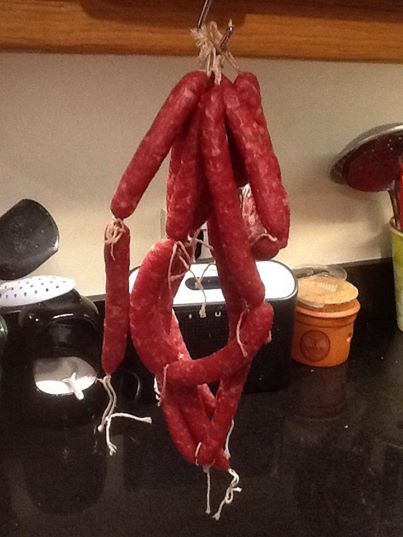
    Here is the recipe for Chinese sausage (lop ch’eung) that we followed for our recent attempt. We think, though that the five spice should be doubled at least, and a mixture of light and dark soy should be used to give a darker colour.

    sausages hanging

    Ingredients

    • 2.25kg pork shoulder
    • 350g pork fat diced into small cubes
    • 70g sugar
    • 50ml soy sauce
    • 50ml rice wine
    • 35g salt
    • 7g Prague powder #2
    • 3g five spice powder
    • 3g ground white pepper
    • sheep casings 22-24mm

    Method

    Mince the meat through the coarse disk twice. Add the diced fat. Mix all of the dry ingredients together and mix well into the meat.

    Add the rice wine and soy sauce, mix thoroughly.

    Refrigerate for 24 hours.

    Stuff into the sausage casings. Use string or straw to form links.

    Dehydrate at 60 degrees C until the sausages lose 30% of their weight.

    Vacuum pack and store.

  • We have sold the shop

    Well, as the title of this post suggests, we (Ince Web Services Limited) have sold Oriental Food Shop.

    The new owners are Tai Fat C&C Limited, and the management team are Eric Lo and his wife Kan. Eric is the brother of Allen Lo, who runs the Tai Fat supermarket in Leicester.

    Here are answers to some of the questions this post may elicit.

    Why did you sell the shop?

    Because we have spent nine year building it to what it is now, and feel that it is time for us to move on to something new. It’s hard work, and whilst we love it, the shop has used up a lot of the time we would like to have spent with our family doing ordinary, family activities.

    Is there a transition period?

    Yes, we will be spending several weeks doing knowledge transfer, providing support and manpower until the new owners are confident and ready to go it alone.

    What about the staff?

    All staff are transferred under TUPE regulations and have continuity of employment rights. We’re going to miss working with them, obviously, but intend to stay in touch.

    What about the customers?

    There are some lovely customers who have supported us over the years and who it has been a pleasure to serve. We will miss them, but hope that they will find the same level of service from the new owners. We haven’t made a big announcement to customers, because the transition is intended to be gradual and seamless.

    What about the website?

    We retain ownership of the domains and website associated with orientalfoodshop.com but have no plans to continue selling on-line ourselves – we would really need the stock and warehouse we enjoyed before in order to make it profitable. If somebody makes an offer for the domains, we will consider it on its merits.

    What will you do next?

    Short term, take a holiday – we haven’t had one of those for many years. Longer term, a new business venture – we aren’t ready to say what that would be yet.

  • Bread and Butter Pudding

    This worked quite well.

    bread-and-butter-pudding

    Ingredients

    • 500ml milk
    • 60g butter, cubed
    • 2 eggs, beaten
    • 100g caster sugar
    • 1 teaspoon vanilla extract
    • 1 teaspoon brandy (optional)
    • 1 teaspoon lemon or orange zest (optional)
    • 3/4 teaspoon ground cinnamon
    • 1/4 teaspoon grated nutmeg
    • 6 slices brioche, cubed
    • 75g raisins

    Method

    Warm the milk, take a couple of tablespoons and whisk in to the eggs. Melt the butter into the milk and beat in the egg mixture, together with the sugar, vanilla, brandy, zest and spices.

    Put the cubed brioche into an oven-proof dish and pour over the milk mixture.

    Bake at 200 degrees celsius for 40 minutes.


  • Nigella’s Praised Chicken

    I’m worried that we might not always be able to access Nigella’s Praised Chicken recipe online. Here is our slightly simplified version.

    Ingredients

    • 1 large chicken
    • 2 teaspoons olive oil
    • 1 clove of garlic
    • 100 ml white wine
    • 2 leeks (cleaned, trimmed & cut into 5cm logs)
    • 3 carrots (peeled & cut into 5cm batons)
    • 1 stick of celery (sliced into 5cm lengths)
    • approx. 2 litres boiling water
    • 1 bouquet garni (or 1 teaspoon dried herbs)
    • 2 teaspoons salt
    • 2 teaspoons crushed black peppercorns
    1. Get out a large, cooking pot (with a lid) in which the chicken can fit snugly.
    2. On a washable board, un-truss the chicken, put it breast-side down and press down until you hear the breastbone crack. Then press down again, so that the chicken is flattened slightly. Now cut off the ankle joints below the drumstick.
    3. Put the oil in the pan to heat, add the garlic, roughly crushed, then brown the chicken for a few minutes breast-side down, and turn up the heat and turn over the chicken, then use the wine to deglaze the pan and let it bubble down a little before adding the leeks, carrots and celery.
    4. Pour in enough boiling water to cover the chicken, though the very top of it may poke out, then pop in the bouquet garni or dried herbs.
    5. The chicken should be almost completely submerged by now and if not, add some more boiling water. You want it just about covered.
    6. Bring to a simmer, put on the lid, turn the heat to very low and leave to cook for 1½–2 hours.
    7. Carefully lift the chicken out of the pan, and take some of the cooking liquid, skimmed, to make gravy. “Pull” the chicken and serve.
  • Bacon Recipe

    I sometimes find myself ranting about bacon in the supermarket – the injected water, the nitrates, the white gunk when you cook it. Grace and I went to the River Cottage HQ near Axminster to learn about curing and smoking, and today we started to make the dry-cured (pancetta style) bacon. Here’s the recipe:

    Ingredients

    • 1 whole pork belly, bone in, divided into three pieces
    • 1kg salt
    • 1 kg demerara sugar
    • four bay leaves, thinly sliced
    • 20 juniper berries, lightly crushed
    • 25g freshly ground black pepper
    • malt vinegar

    Method

    Mix the salt, sugar and flavouring ingredients, reserve the vinegarSprinkle the cure on the bottom of a clean box. Place the first piece of belly skin down, and add a nother layer of the cure, making sure that it is rubbed into the sides. Add the other two pieces of belly, repeating the layering with the cure.

    Put a lid on the box and store in a cold pace / refrigerator. after 24 hours drain the liquid, and rub the belly pieces with more of the cure mix. Re-stack (rotating the bellies so the top one goes to the bottom) and return to the fridge.

    Repeat this process for four days.

    Wash the cure form the belly pieces, and then clean their surfaces with the vinegar. Pat dry, then hang in a cool dry place for 7 to 10 days before using. Slice as required, removing bones as you come to them. Can be stored in the fridge for around a month.

  • Renaming a Windows 8 User Folder

    If you use Microsoft authentication when creating a new user, you can end up with an inconvenient user folder name. This can be changed as follows:

    1. Login as a user with administrative privileges.
    2. If necessary, rename the the user. (Win+X, G (Computer Management) → System Tools → Local Users and Groups → Users, right-click user, Rename.)
    3. From the command prompt rename the user folder. (Win+X, A (Command Prompt (Admin)) and ren C:\Users\oldname newname)
    4. Now use the registry editor to change the path for the SID of the relevant user:
    • Win+X, R (Run)
    • regedit
    • Navigate to HKEY_LOCAL_MACHINE\SOFTWARE\Microsoft\Windows NT\CurrentVersion\ProfileList\
    • Click onto each SID and check ProfileImagePath for the old folder name (e.g. c:\Users\oldname). When you have found the relevant SID, change the value for ProfileImagePath to the new folder, e.g. c:\Users\newname

    Login using the new username and check all is working correctly.

  • Risotto in the Rice Cooker

    Ingredients

    • 1 tablespoon olive oil
    • 1 tablespoon butter
    • 2 carrots, diced
    • 1 small onion, finely chopped
    • 1 cup arborio rice
    • 3 cups chicken stock (or vegetable stock)

    Method

    1. Put oil and butter in rice cooker pot, switch on.
    2. When butter is melted, add carrots and onions. Cook until softened, 3-5 minutes.
    3. Add rice, stir until it is coated with oil.
    4. Add chicken stock and switch to cook.
    5. Check consistency when rice cooker switches to warm. If it is too chewy, add 1/4 cup water and switch on again.

    Serves 4-6